
The AcumenIST-coordinated MACRAMÉ Project has published twelve recommendations to address gaps in AdMas characterisation & identification, safety testing, transformation & release, and information flow. Within the project, experts developed advanced characterisation methodologies to assess and predict the risks of advanced materials. Based on the experiences MACRAMÉ gained on the testing of graphene-related materials, carbon nanotubes and poly(lactic-co-glycolic) acid (PLGA) incorporated in market-relevant products, along their life cycle, the project developed these twelve recommendations.
The recommendations are grounded in collaborative research, and targeted stakeholder consultations, including regulators, scientists, industry representatives (large companies, small and medium-size enterprises, testing laboratories) and experts from standardisation bodies and the OECD. The recommendations aim to identify specific methodological needs and to guide future work towards OECD Test Guidelines, Guidance Documents, and ISO/CEN standards. By advancing harmonised approaches and data comparability, the recommendations support regulatory testing that is manageable for industry, acceptable to regulators, and trusted by stakeholders.
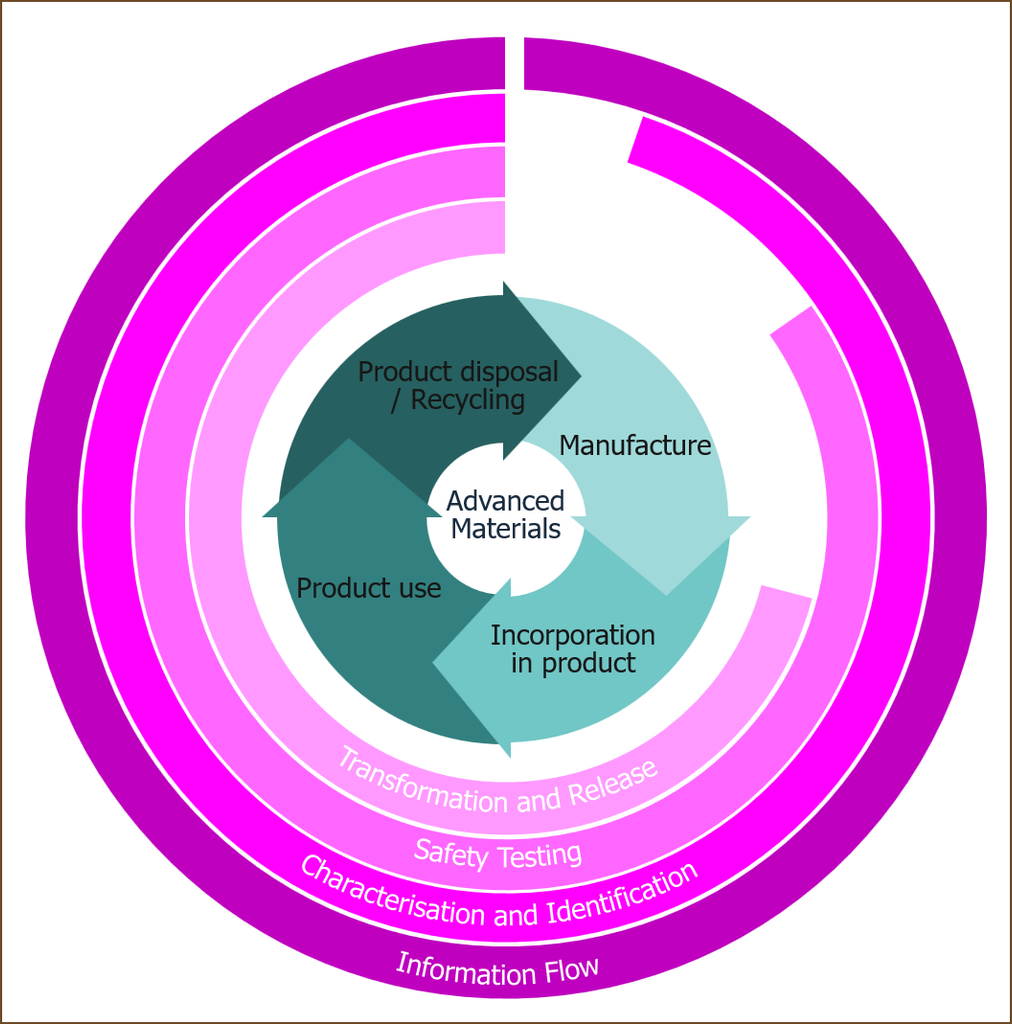
Together, the twelve recommendations form a coherent framework that links scientific method development with regulatory implementation and are a key outcome of MACRAMÉ. They reflect both the progress achieved in identifying methodological needs for AdMas and the limitations that remain in terms of validation, international alignment, and practical uptake. The recommendations should be understood as a living set of priorities rather than fixed endpoints. They illustrate where further work is needed to bridge the gap between scientific method development and regulatory application. Looking ahead, the recommendations can serve as a foundation for future collaborations, research projects, and standardisation initiatives.
The MACRAMÉ project encourages the European Commission, OECD Member Countries and all involved stakeholders to support the advancement of Test Guidelines and standards as identified in the recommendations by implementing the following activities.
The full text publication can be read here.
Pohl A, Haase D, Bleeker EAJ, Ouhajji S, Weltring K-M, Wiemann M, Katsumiti A, Seitz C, Gupta G, Ortiz-Galvez LM, Buerki-Thurnherr T, Wick P, Exner TE, Suarez-Merino B, Mentler R, Serchi T, Reilly K, Lynch I, Friedrichs S and Heunisch E (2026) Towards test guidelines and standards for advanced materials: scientific insights and recommendations from the MACRAMÉ project. Front. Toxicol. 8:1895021. doi: 10.3389/ftox.2026.1895021